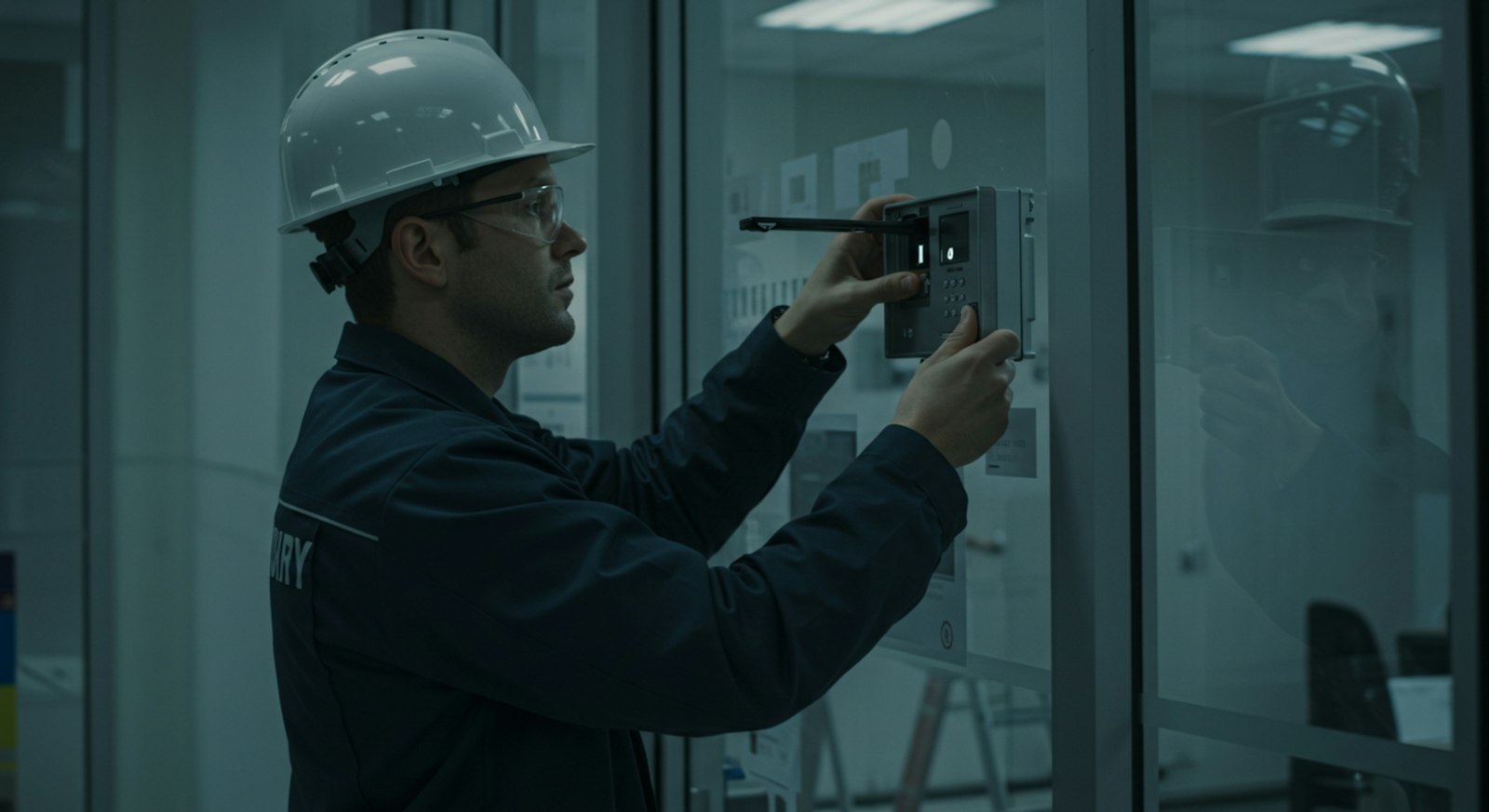
The number you actually pay depends on three things: whether the kit is wireless or hardwired, whether the company waives fees for a monitoring contract, and how many devices need mounting. This guide breaks down each fee with the source and date, since installation prices drift less than equipment prices but still change.
Installation and activation fees by company
| Company | Installation fee | Activation fee |
|---|---|---|
| ADT | $99–$299 | $99 |
| Brinks Home | $199–$299 | $99 |
| CPI Home Security | $99–$199 | $79 |
| Frontpoint Security | $0 | $99 |
| Link Interactive | $0–$199 | $99 |
| Xfinity | $99–$199 | $99 |
| Vivint Security | $0–$199 | $0 |
| SimpliSafe | $0–$50 | $0 |
| Ring | $0 | $0 |
| Wyze | $0 | $0 |
What the installation fee covers
HomeGuide describes professional installation as mounting and connecting cameras, sensors, video doorbells and other equipment, then testing the system so every piece works. A good installer also pairs the panel with your Wi-Fi, walks you through the app and sets entry and exit delays so you do not set off the siren coming home.
That bundle sounds like a lot, but for a wireless kit the work is simple. Fixr says most wireless systems can be installed by the homeowner in under an hour. A technician earns the fee mainly on hardwired systems, outdoor cameras that need power, and homes where signal strength is a problem.
The fee usually stops at the install. Equipment, monitoring, extra sensors added later and any repair visit are billed separately. Fixr lists a $50 repair service call in its Vivint entry, which shows how a small recurring fee can sit outside the install price.
Labor and wage benchmarks
| Measure | Figure | Source and date |
|---|---|---|
| Installer labor, hourly rate charged | $60–$150 | Fixr, January 2025 |
| Professional installation on systems that require it | $90–$400 | Fixr, January 2025 |
| Activation fee | $25–$100 | Fixr, January 2025 |
| Drywall repair after hardwired install | $75–$350 | Fixr, January 2025 |
| Installer mean hourly wage (wage, not customer rate) | $29.31 | BLS OEWS, May 2025 |
| Installer median hourly wage | $28.88 | BLS OEWS, May 2025 |
| Installer 90th percentile hourly wage | $39.01 | BLS OEWS, May 2025 |
Company-specific installation prices from Fixr
| Company | Installation figure |
|---|---|
| Abode | Professional installation $100, activation $25 |
| SimpliSafe | Professional installation $80 |
| Xfinity | Installation $60–$100 |
| ADT | Same-day installation $100 |
| Brinks | Installation added to lower packages $200 |
| Vivint | Activation $100 |
How "free installation" works
"Free installation" is common, and it is rarely free. HomeGuide's table shows ADT at $99–$299 and Brinks at $199–$299 for installation, while Frontpoint, Ring and Wyze list $0. The $0 listings split into two groups: DIY brands that never charge, and companies that waive the fee in exchange for a monitoring contract.
Contract lengths are where the cost hides. HomeGuide lists ADT at 3 years and Vivint at 42 or 60 months. Fixr estimates that equipment discounts on a three-year contract run $600 to $2,160, and the FTC's 2024 click-to-cancel amendments would have required cancellation to be as easy as signup. A federal appeals court vacated those amendments in July 2025, and the FTC's March 13, 2026 notice says the older 1973 rule is back in place while it considers a new one, so read the cancellation terms instead of assuming protection.
Ask three questions before you accept a free install: what is the contract term, what is the early termination fee, and what happens to the equipment if you move. If the answers are not written down, the offer is not free, it is unpriced.
Wired versus wireless: where labor jumps
Wireless kits are the reason installation prices have fallen. Sensors stick on with adhesive, the hub plugs into an outlet and a cellular or Wi-Fi link does the rest. HomeGuide notes that wired systems typically require a licensed electrician and often involve cutting into walls to run electrical and telephone wiring.
That labor shows up in the invoice. Fixr puts drywall repair after a hardwired install at $75 to $350 and installer rates at $60–$150 an hour, so a wired job that takes six hours can approach $360–$900 in labor before any wall repair. The six-hour figure is an illustration, but the hourly range is Fixr's.
Many wired systems now include wireless backup, per HomeGuide, so the panel has a second way to report if a line fails. If you own a new build or are already opening walls for a remodel, wiring is cheaper to run at that point than afterward. In a finished home, wireless is almost always the better value.
Professional versus DIY installation
The difference is not only dollars. A DIY kit costs $0 in labor and takes an afternoon. A professional install adds anywhere from $0 to $299 per HomeGuide, and companies like SimpliSafe will connect you with a certified pro if you want help, according to its packages page.
Ring's pages show that DIY can cover doorbells too. HomeGuide's Ring guide (March 2024) says Ring's optional professional installation costs $129.99 to $259.99, which can exceed the price of the doorbell on sale. Ring's November 2026 sale prices put a wired doorbell at $39.99, so a pro would cost three to six and a half times as much as the device.
Pay a professional when the install touches wiring, ladders or your electrical panel: floodlight cameras on a second story, a doorbell with no existing wiring, or hardwired sensors. Do it yourself for everything that sticks, plugs in or runs on batteries.
Why labor rates look high next to wages
The Bureau of Labor Statistics tracks security and fire alarm systems installers under code 49-2098. Its May 2025 data shows a national employment of about 86,340 workers, a mean wage of $29.31 an hour, a median of $28.88 and a 90th percentile of $39.01. At the low end, the 10th percentile is $18.65.
A customer rate of $60 to $150 an hour looks steep next to those wages, but a company's rate pays for the van, tools, insurance, dispatch and the time between jobs. A simple way to sanity-check a quote: divide the labor total by the hours you were told the job would take. If the number is far above $150 an hour, ask what else is in it.
Some quotes are flat rates instead. That is fine as long as the scope is written down, including how many sensors, whether cameras are included and who patches the drywall if holes are drilled.
Extra charges that show up on the day
Installation quotes often leave out items that appear on the invoice. Fixr lists activation fees of $25 to $100, HomeGuide lists $79 to $99 and says most companies waive it with a monitoring plan. Permit or registration fees for alarm systems vary by city, and some jurisdictions require them before the system goes live, so ask who files the paperwork.
Add-ons increase the bill. A technician who is already on site can add a smart lock, a doorbell camera or a smoke detector, and Fixr lists those at $150 to $400, $50 to $400 and $30 to $100. Each addition raises both equipment and labor.
Finally, ask whether the company will move the system if you do. A DIY kit goes with you in a box. A hardwired panel stays in the wall, and some contracts charge a transfer fee.
Comparing quotes and preparing for install day
Put both quotes in the same four columns: equipment, installation labor, activation, and contract length. A quote that lists only a monthly price and a free install is hiding at least two of those columns. Ask for the missing numbers by email so you have them in writing.
Then run the three-year math. Take the equipment price, add every one-time fee, and add the monthly plan times 36. A company with a $199 install fee and a month-to-month plan can end up cheaper than one with a free install and a 36-month term. HomeGuide's monitoring range is $25–$50 a month, and over 36 months that is $900 to $1,800 before equipment, so a $10 difference in the monthly fee adds $360 over 36 months, more than a $299 install fee.
Check what happens when something breaks. Ask whether a service visit is free during the contract, who owns the equipment, and what the company charges to move or remove it. Fixr lists a $50 repair call on one company's page, a reminder that even small visits can carry a fee.
Finally, compare how each company treats cancellation. Month-to-month plans from Abode, Wyze and Cove carry no contract on their pages. Longer contracts can be fine if the price is right, but only if you plan to stay in the home for the full term.
A little preparation keeps the bill from growing. Walk the house with a pen and list every exterior door, ground-floor window and any place you want a camera. Bring that list to the quote so the sensor count is agreed up front, not added on the day at a higher price.
Check your internet and power. A system that depends on Wi-Fi is only as good as the signal at the panel and the cameras, and an extender or a wired connection can solve it. If you want a doorbell camera and your house has no doorbell wiring, mention it before the visit because that can turn a short job into an electrician job.
If you rent, read the lease and ask the landlord about drilling, exterior mounting and alarm permits. Many renters choose no-drill wireless kits for exactly that reason, and SimpliSafe's page says its system needs no drilling or tools. Finally, keep every receipt and manual in one folder. If you cancel later, the paperwork that shows what you bought and when is the strongest evidence you have.
Example bill
Sample installation bill: 3-bedroom house, wireless 8-piece kit set up by a technician
- Ring Alarm 8-piece kit (November 2026 sale price)
- $249.99
- Installer labor, 2 hours at $60 an hour (low end of Fixr's rate)
- $120
- Activation fee (waived with monitoring)
- $0
- Total
- $369.99
An illustration, not a quote. The two-hour job length is an assumption; the $60 rate is the bottom of Fixr's $60–$150 range, and the activation waiver is common according to HomeGuide.
Contract traps to check
- Free installation tied to a long contract. HomeGuide lists ADT at 3 years and Vivint at 42 or 60 months, and Fixr says the equipment discount can be $600–$2,160.
- Activation fees added at checkout. HomeGuide lists $79–$99 and Fixr $25–$100. Ask whether the fee is waived and get it in writing.
- Hourly billing without a scope. Fixr's $60–$150 range is wide. Ask for a flat price or an hour estimate.
- Drywall repair not included. Hardwired jobs can add $75–$350 (Fixr).
- A second visit for add-ons. A return trip can mean a second service charge. Ask which sensors you will want before the technician arrives.
How to pay less
- Choose a wireless kit. Fixr says most can be installed by the homeowner in under an hour, which removes the labor line.
- Ask for activation to be waived. HomeGuide says many companies do this with a monitoring plan.
- Skip professional install on doorbells. Ring's own optional service is $129.99–$259.99 in HomeGuide's Ring guide, more than the device.
- Get two quotes with a written scope. Compare the labor hours and hourly rate, not only the total.
- Install during a remodel. If walls are already open, wiring is cheaper than drywall repair later.
Questions people ask
How much does it cost to install a home security system?
HomeGuide reports $0 to $299 for installation and activation combined. Fixr gives $90 to $400 for systems that require a professional. Hourly rates run $60 to $150 per Fixr. DIY wireless kits cost nothing to install.
Is professional installation worth it?
For hardwired systems, outdoor cameras that need power and ladder work, usually yes. For wireless kits that stick on and plug in, Fixr says most homeowners finish in under an hour, so the fee rarely pays for itself.
Do security companies really install for free?
Some do, but usually in exchange for a monitoring contract. HomeGuide lists ADT at 3 years and Vivint at 42 or 60 months. Fixr notes equipment discounts of $600–$2,160 tied to three-year deals.
What is an activation fee?
A one-time charge to turn on your service. HomeGuide lists $79–$99 and Fixr lists $25–$100. Many companies waive it if you sign up for monitoring, so ask before you pay.
How long does installation take?
A wireless kit takes under an hour for a homeowner per Fixr. Professional jobs on hardwired systems take longer. Ask for an estimate and a written scope.
Can I install it myself if I rent?
Often yes with a wireless, no-drill kit. SimpliSafe's page says its system arrives ready to work with no drilling or tools needed. Check your lease for restrictions on alarms and exterior mounting.
Sources
Prices checked November 23, 2026
- Home Security System Cost, HomeGuide, checked November 23, 2026Used for: equipment, installation, activation and monthly monitoring ranges (page dated April 17, 2024)
- Home Security System Prices, Fixr, checked November 23, 2026Used for: national average, installer hourly rate, equipment and add-on ranges (updated January 31, 2025)
- How Much Does a Ring Doorbell Cost?, HomeGuide, checked November 23, 2026Used for: doorbell and Ring equipment price table, optional Ring installation range (page dated March 16, 2024)
- OEWS May 2025, 49-2098, hourly mean wage (series OEUN000000000000049209803), U.S. Bureau of Labor Statistics, checked November 23, 2026Used for: national mean hourly wage for security and fire alarm systems installers: $29.31
- OEWS May 2025, 49-2098, hourly median wage (series OEUN000000000000049209808), U.S. Bureau of Labor Statistics, checked November 23, 2026Used for: national median hourly wage: $28.88
- OEWS May 2025, 49-2098, 90th percentile hourly wage (series OEUN000000000000049209810), U.S. Bureau of Labor Statistics, checked November 23, 2026Used for: 90th percentile hourly wage: $39.01
- OEWS May 2025, 49-2098, 10th percentile hourly wage (series OEUN000000000000049209806), U.S. Bureau of Labor Statistics, checked November 23, 2026Used for: 10th percentile hourly wage: $18.65
- OEWS May 2025, 49-2098, employment (series OEUN000000000000049209801), U.S. Bureau of Labor Statistics, checked November 23, 2026Used for: national employment of installers: 86,340
- Ring Doorbell Cameras, Ring, checked November 23, 2026Used for: battery and wired doorbell sale and list prices
- Shop DIY Home Security Systems and Packages, SimpliSafe, checked November 23, 2026Used for: 60-day return window, no drilling or tools needed (package prices did not render)
- Negative Option Rule, Federal Trade Commission, checked November 23, 2026Used for: rule page listing the February 12, 2026 Federal Register notice and the March 13, 2026 advance notice of proposed rulemaking
- Negative Option Rule, advance notice of proposed rulemaking (Federal Register, March 13, 2026), Federal Trade Commission, checked November 23, 2026Used for: the Eighth Circuit vacated the 2024 amended rule in July 2025, which reinstated the 1973 rule; comments on a new rulemaking were due April 13, 2026
- Click to Cancel: the FTC's amended Negative Option Rule, Federal Trade Commission, checked November 23, 2026Used for: what the 2024 rule asked of sellers: disclose terms, cancel by the same method as sign-up (post dated October 2024)